Simmer Down
Miloš Kopták
17. 7. − 5. 9. 2026
Curator: Andrej Jaroš

ABOUT THE EXHIBITION
The title of the project functions both as a personal mantra and as a socio-critical mirror that can be read on two levels. On the one hand, it represents the artist’s own inner monologue, through which he seeks self-discipline and calm in reduced forms amid creative and social pressure. On the other, it is a direct appeal to the viewer. Kopták’s latest canvases do not invite the rapid consumption of a visual experience, but rather demand prolonged, contemplative stillness.
We live in an age of constant online hyperactivity, information noise, geopolitical turbulence and social anxiety. Kopták does not respond to this condition through passive escape, but, paradoxically, through a visual cry that searches for a point of calm within the very act of destroying and reconstructing form. His latest paintings constitute a variable series devoted to the pursuit of tranquillity and silence, in which the boundary between the artist’s inner unrest and his attempt to establish a new visual order gradually dissolves.The intimate setting of Bratislava’s Flatgallery thus becomes a place of temporary deceleration and quiet.
Within the context of Kopták’s previous work, we can observe his continuing interest in appropriation, the adoption and subsequent transformation of existing source material, visual stereotypes and historical artistic movements, as seen, for instance, in his earlier cycles responding to Neo-Suprematism. In the latest series of paintings exhibited at Flatgallery, however, the artist loosens and minimises his visual language even further. He enters into a dialogue with his own superego. The figure and sexuality, however present they may remain, disintegrate beneath layers of expressive gestures and transform into abstract topographies of the human mind and geometric forms.
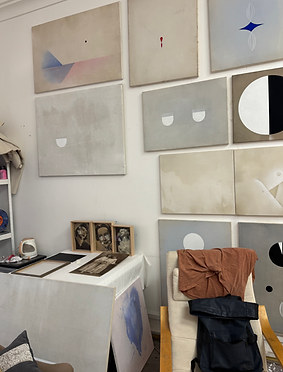
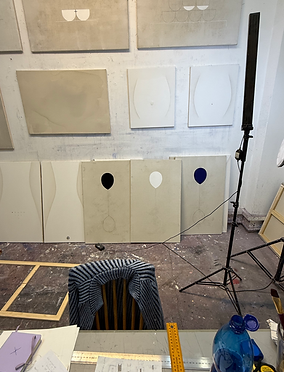
Kopták reduces forms and shapes to a minimum, yet paradoxically achieves maximum internal tension. The circle in his paintings is not merely a passive geometric form. It becomes a target, a horizon, a mandala, a psychological mirror, a sexual charge, an erotic pictogram, or a personification of the search for mental calm in an unsettled age.
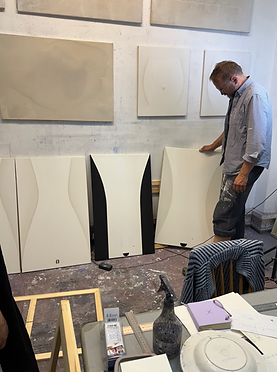
The deliberately restricted monochromatic palette, built around subtle shades of grey, muted ochre, white and deep, dominant black, with accents of red and blue, points towards the modernist principles of the Bauhaus. Yet the artist intentionally disrupts the monochromatic surfaces and precise lines through small details: delicate incisions, horizontal lines cutting across the clean surface of a circle, or sudden shifts in material and colour.
Each canvas operates as an autonomous visual entity. Placed alongside one another, the exhibited works create a deliberate rhythm, almost a cinematic record of the transformation of form and light. A pure white circle evolves in the following painting into a black-and-white bipolar sphere; elsewhere, it is intersected by a vertical line. Through these interventions, the artist opens up themes of fragile balance and charged tension, the duality of masculine and feminine principles, as well as the infinite nuances existing between these apparent opposites.
The distinctive residential character of the gallery adds another interpretative dimension to Kopták’s works. The intimate, domestic environment contrasts with the force and rawness of the exhibited canvases and objects. The viewer does not stand before the works at the detached distance imposed by the sterile public space of the white cube, but becomes a direct witness to the artist’s mental struggle within a real, lived-in interior. Here, the paintings function not merely as aesthetic objects, but as living entities with which we must share a common space and through which we are compelled to confront our own inner unrest.
With this exhibition, Miloš Kopták demonstrates that finding calm through artistic creation does not imply stagnation. Instead, he reveals the courage required to strip form of unnecessary ballast, abandon figurative narration and place trust in the power of painterly gesture and geometry itself.
The exhibition at Flatgallery therefore offers a unique opportunity to experience Kopták’s work in its purest, most meditative and intellectually mature form, carrying a profound and resonant message.